Technical Documents
Specifications
Brand
StarTech.comProduct Type
Ethernet Cable
Series
N6SPAT5MBK
Cable Length
5m
LAN Category
Cat6
Sub Type
Shielded Snagless
Shield Type
Shielded
Screened/Unscreened
Screened
Conductor Type
Stranded
Jacket Material
Polyvinyl Chloride
Jacket Colour
Black
Minimum Operating Temperature
0°C
Maximum Operating Temperature
50°C
Fire Behaviour
CMG Rated
Standards/Approvals
CE, REACH, RoHS
Cross Sectional Area
26 AWG
Conductor Material
Copper
Country of Origin
China
Product Details
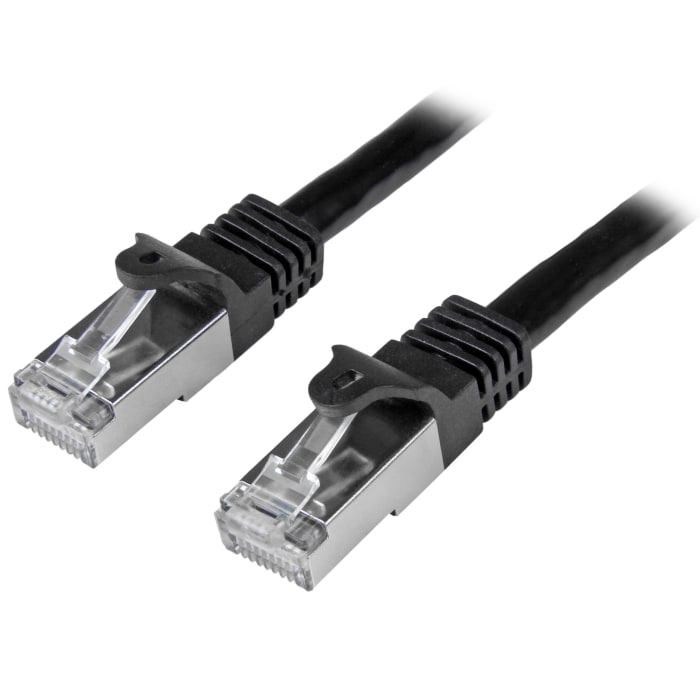
This 5-meter Cat6 cable meets or exceeds all Category 6 cable specifications to ensure reliable Gigabit network connections. The cable is shielded to protect your network against electromagnetic interference (EMI/RFI) and system noise, providing the perfect solution for fast and safe network connections.
Reliable Cat 6 Gigabit connections
Constructed with 100% copper and foil-shielded twisted-pair wiring, this cable delivers high-quality performance. Its designed to keep the data signals traveling through your network free from interference, so it's perfect in environments that are prone to large amounts of EMI.
The 50-micron gold connectors deliver optimum conductivity and eliminate signal loss due to oxidation or corrosion.
Secured network connections
For easier cable runs, the snagless connectors protect the RJ45 clips during installation, making them less likely to snag or break. This ensures a sturdy connection by preventing the cable from becoming loose from the port.
Plus, the moulded boots offer strain relief that stops the RJ45 connector termination points from bending at sharp angles, which reduces the risk of damage to the cable that could decrease network performance.
The N6SPAT5MBK is backed by StarTech.coms lifetime warranty for guaranteed reliability.
What is a Cat6 cable used for?
Cat6 or Category 6 cables are typically used for connecting computers to another device, like router, hub or modems and ISPs to allow the sharing of data across a network or for accessing the internet. Typically, Cat6 cables permit a higher frequency of 250Mhz and can be used over a maximum distance of 55m for 10GBASE-T.
What is the difference between Cat6 and Cat5/5e cables?
Cat ethernet cables have undergone significant development over the years with improved features and performances. The key difference between Cat 6 over the Cat5 & Cat5e is not only the higher speeds but also the reduced crosstalk or commonly known as interference with other cables. Reduced crosstalk is primarily improved with better shielding and twisted cable design. Cat6 can perform up to 250MHz whilst Cat5e can only operate up to 100MHz.
Whats the difference between a cat6 patch lead and a crossover cable?
A cat6 patch lead or cable, also known as a straight through cable, is used for connecting devices of different types, like a computer to a switch or hub.
Ethernet crossover cable on the other hand is used for connecting two types of the same device together e.g. two computers.
Stock information temporarily unavailable.
€ 16.36
€ 16.36 Each (Exc. VAT)
1
€ 16.36
€ 16.36 Each (Exc. VAT)
Stock information temporarily unavailable.
1
Technical Documents
Specifications
Brand
StarTech.comProduct Type
Ethernet Cable
Series
N6SPAT5MBK
Cable Length
5m
LAN Category
Cat6
Sub Type
Shielded Snagless
Shield Type
Shielded
Screened/Unscreened
Screened
Conductor Type
Stranded
Jacket Material
Polyvinyl Chloride
Jacket Colour
Black
Minimum Operating Temperature
0°C
Maximum Operating Temperature
50°C
Fire Behaviour
CMG Rated
Standards/Approvals
CE, REACH, RoHS
Cross Sectional Area
26 AWG
Conductor Material
Copper
Country of Origin
China
Product Details
This 5-meter Cat6 cable meets or exceeds all Category 6 cable specifications to ensure reliable Gigabit network connections. The cable is shielded to protect your network against electromagnetic interference (EMI/RFI) and system noise, providing the perfect solution for fast and safe network connections.
Reliable Cat 6 Gigabit connections
Constructed with 100% copper and foil-shielded twisted-pair wiring, this cable delivers high-quality performance. Its designed to keep the data signals traveling through your network free from interference, so it's perfect in environments that are prone to large amounts of EMI.
The 50-micron gold connectors deliver optimum conductivity and eliminate signal loss due to oxidation or corrosion.
Secured network connections
For easier cable runs, the snagless connectors protect the RJ45 clips during installation, making them less likely to snag or break. This ensures a sturdy connection by preventing the cable from becoming loose from the port.
Plus, the moulded boots offer strain relief that stops the RJ45 connector termination points from bending at sharp angles, which reduces the risk of damage to the cable that could decrease network performance.
The N6SPAT5MBK is backed by StarTech.coms lifetime warranty for guaranteed reliability.
What is a Cat6 cable used for?
Cat6 or Category 6 cables are typically used for connecting computers to another device, like router, hub or modems and ISPs to allow the sharing of data across a network or for accessing the internet. Typically, Cat6 cables permit a higher frequency of 250Mhz and can be used over a maximum distance of 55m for 10GBASE-T.
What is the difference between Cat6 and Cat5/5e cables?
Cat ethernet cables have undergone significant development over the years with improved features and performances. The key difference between Cat 6 over the Cat5 & Cat5e is not only the higher speeds but also the reduced crosstalk or commonly known as interference with other cables. Reduced crosstalk is primarily improved with better shielding and twisted cable design. Cat6 can perform up to 250MHz whilst Cat5e can only operate up to 100MHz.
Whats the difference between a cat6 patch lead and a crossover cable?
A cat6 patch lead or cable, also known as a straight through cable, is used for connecting devices of different types, like a computer to a switch or hub.
Ethernet crossover cable on the other hand is used for connecting two types of the same device together e.g. two computers.