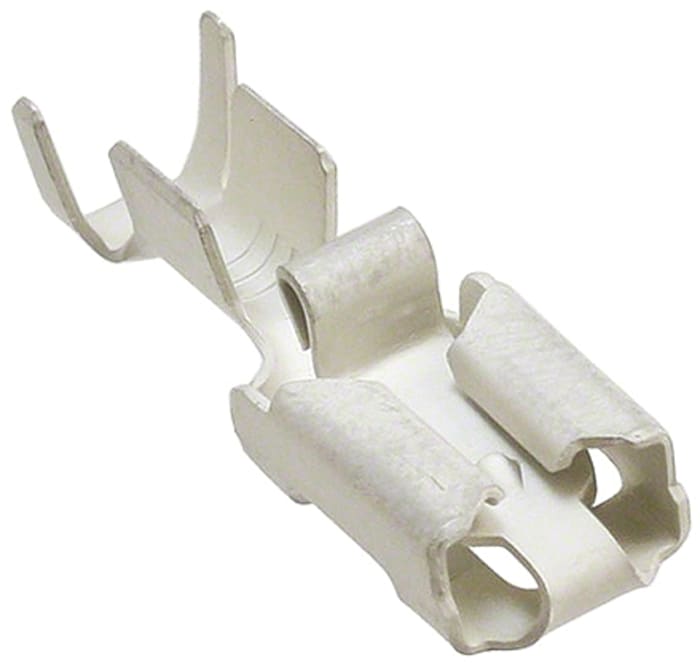
TE Connectivity Positive Lock .250 Mk I Silver Uninsulated Female Spade Connector, Crimp, 6.35 x 0.81 mm Tab Size 13 AWG

Technical Document
Specifications
Brand
TE ConnectivityTermination Type
Crimp
Product Type
Spade Connector
Gender
Female
Tab Width
6.35mm
Tab Thickness
0.8mm
Tab Size
6.35 x 0.81 mm
Insulation
Uninsulated
Maximum Wire Size AWG
11 AWG
Minimum Wire Size AWG
13 AWG
Colour
Silver
Contact Material
Phosphor Bronze
Contact Plating
Tin
Orientation
Straight
Standards/Approvals
No
Overall Length
22.5mm
Series
Positive Lock .250 Mk I
Product details
TE Connectivity Positive Lock Connector Contacts - MK I 250 Series
MK I 250 Series positive lock receptacle and flag style crimp terminals with reduced insertion force and snap action locking which accept a wire size range of 20 to 10 AWG. These Positive Lock crimp receptacles lock onto the mating tab terminals containing holes or dimples and make a mechanical 'snap' when correctly positioned and can only be removed when an integral depressor on the receptacle terminal is deflected.
TE Connectivity Positive Lock Range
Ideate. Create. Collaborate
JOIN FOR FREE
No hidden fees!


- Download and use our DesignSpark software for your PCB and 3D Mechanical designs
- View and contribute website content and forums
- Download 3D Models, Schematics and Footprints from more than a million products
Stock information temporarily unavailable.
Price on asking
Each (In a Pack of 100) (Exc. VAT)
100
Price on asking
Each (In a Pack of 100) (Exc. VAT)
Stock information temporarily unavailable.
100
Ideate. Create. Collaborate
JOIN FOR FREE
No hidden fees!
- Download and use our DesignSpark software for your PCB and 3D Mechanical designs
- View and contribute website content and forums
- Download 3D Models, Schematics and Footprints from more than a million products
Technical Document
Specifications
Brand
TE ConnectivityTermination Type
Crimp
Product Type
Spade Connector
Gender
Female
Tab Width
6.35mm
Tab Thickness
0.8mm
Tab Size
6.35 x 0.81 mm
Insulation
Uninsulated
Maximum Wire Size AWG
11 AWG
Minimum Wire Size AWG
13 AWG
Colour
Silver
Contact Material
Phosphor Bronze
Contact Plating
Tin
Orientation
Straight
Standards/Approvals
No
Overall Length
22.5mm
Series
Positive Lock .250 Mk I
Product details
TE Connectivity Positive Lock Connector Contacts - MK I 250 Series
MK I 250 Series positive lock receptacle and flag style crimp terminals with reduced insertion force and snap action locking which accept a wire size range of 20 to 10 AWG. These Positive Lock crimp receptacles lock onto the mating tab terminals containing holes or dimples and make a mechanical 'snap' when correctly positioned and can only be removed when an integral depressor on the receptacle terminal is deflected.
TE Connectivity Positive Lock Range
Ideate. Create. Collaborate
JOIN FOR FREE
No hidden fees!
- Download and use our DesignSpark software for your PCB and 3D Mechanical designs
- View and contribute website content and forums
- Download 3D Models, Schematics and Footprints from more than a million products