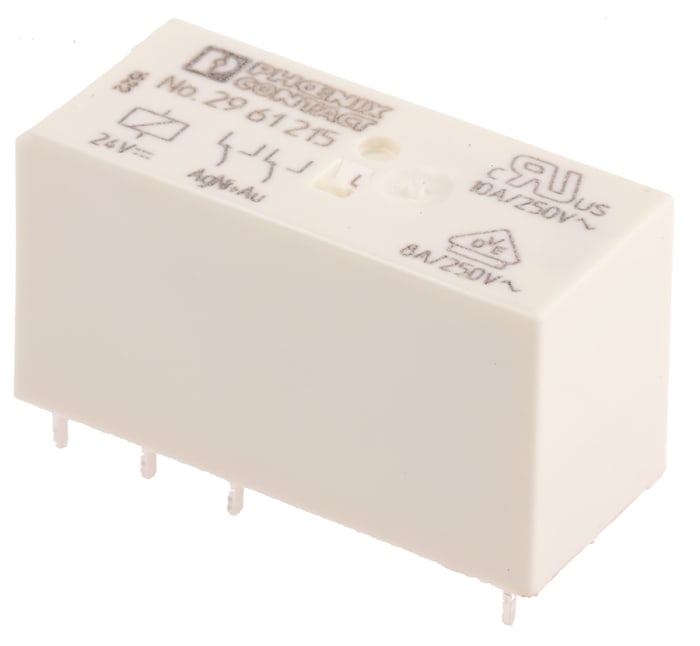
Phoenix Contact PCB Power Relay, 24V dc Coil, 8A Switching Current, DPDT

Technical Document
Specifications
Brand
Phoenix ContactCoil Voltage
24V dc
Product Type
Power Relay
Contact Configuration
DPDT
Mount Type
PCB
Series
REL-MR- 24DC/21-21
Terminal Type
Solder
Switching Current
8A
Minimum Operating Temperature
-40°C
Switching AC Voltage
250V ac
Coil Resistance
1.4kΩ
Maximum Operating Temperature
85°C
Height
15.7mm
Coil Power
2kW
Length
29mm
Standards/Approvals
VDE, UL, RoHS, IEC, EN
Width
12.7mm
Contact Material
Silver Alloy
Country of Origin
Austria
Product details
Phoenix Contact Non-Latching Relays, REL-MR Series
Phoenix contacts REL-MR series of non-latching relays are commonly found within industrial environments, they are considered to be electrical and mechanical devices. This type of relay can often be referred to an electromechanical relay or an industrial switch.
Features & Benefits
• Pluggable miniature relays, with power contact for high continuous current
• Varied switching current dependant on the relay chosen from the REL-MR series
• Pluggable miniature relay - compact in size
• Additional hard gold plating
• AC and DC coil voltages
• Robust and hard wearing
What is a non-latching relay and how do they work?
A relay is an electrical switch that is operated by electrical pulses, their primary function is to open and close a circuit. When power passes through a circuit, a relay switches position (usually from NC to NO) using an internal coil which generates a magnetic force. This force then holds the relay in a NO position, when the current is switched off the relay returns to the NC position. This function is what makes these non-latching relays perfect for push-button applications such as keyboards and micro-controller input buttons.
A little more info
Non-latching relays support a range of signal characteristics, ranging from low voltage or current to high voltage or current and from DC to GHz frequencies.
What is the difference between a latching relay and a non-latching relay?
• When a latching relay operates its contacts, the relay holds its position, even when the supply of its operating coil has been disconnected.
• When a non-latching relay operates its contacts, the relay will reset automatically once the supply of its coil is disconnected through the internal spring mechanism.
Approvals
DIN VDE 0435, DIN VDE 0160, DIN VDE 0631, DIN VDE 0110
Standards
IEC 60255, EN 50178, EN 60730, IEC 60664
Ideate. Create. Collaborate
JOIN FOR FREE
No hidden fees!


- Download and use our DesignSpark software for your PCB and 3D Mechanical designs
- View and contribute website content and forums
- Download 3D Models, Schematics and Footprints from more than a million products
Stock information temporarily unavailable.
€ 8.40
€ 8.40 Each (Exc. VAT)
1
€ 8.40
€ 8.40 Each (Exc. VAT)
Stock information temporarily unavailable.
1
| Quantity | Unit price |
|---|---|
| 1 - 9 | € 8.40 |
| 10 - 49 | € 8.31 |
| 50 - 99 | € 7.94 |
| 100+ | € 7.57 |
Ideate. Create. Collaborate
JOIN FOR FREE
No hidden fees!
- Download and use our DesignSpark software for your PCB and 3D Mechanical designs
- View and contribute website content and forums
- Download 3D Models, Schematics and Footprints from more than a million products
Technical Document
Specifications
Brand
Phoenix ContactCoil Voltage
24V dc
Product Type
Power Relay
Contact Configuration
DPDT
Mount Type
PCB
Series
REL-MR- 24DC/21-21
Terminal Type
Solder
Switching Current
8A
Minimum Operating Temperature
-40°C
Switching AC Voltage
250V ac
Coil Resistance
1.4kΩ
Maximum Operating Temperature
85°C
Height
15.7mm
Coil Power
2kW
Length
29mm
Standards/Approvals
VDE, UL, RoHS, IEC, EN
Width
12.7mm
Contact Material
Silver Alloy
Country of Origin
Austria
Product details
Phoenix Contact Non-Latching Relays, REL-MR Series
Phoenix contacts REL-MR series of non-latching relays are commonly found within industrial environments, they are considered to be electrical and mechanical devices. This type of relay can often be referred to an electromechanical relay or an industrial switch.
Features & Benefits
• Pluggable miniature relays, with power contact for high continuous current
• Varied switching current dependant on the relay chosen from the REL-MR series
• Pluggable miniature relay - compact in size
• Additional hard gold plating
• AC and DC coil voltages
• Robust and hard wearing
What is a non-latching relay and how do they work?
A relay is an electrical switch that is operated by electrical pulses, their primary function is to open and close a circuit. When power passes through a circuit, a relay switches position (usually from NC to NO) using an internal coil which generates a magnetic force. This force then holds the relay in a NO position, when the current is switched off the relay returns to the NC position. This function is what makes these non-latching relays perfect for push-button applications such as keyboards and micro-controller input buttons.
A little more info
Non-latching relays support a range of signal characteristics, ranging from low voltage or current to high voltage or current and from DC to GHz frequencies.
What is the difference between a latching relay and a non-latching relay?
• When a latching relay operates its contacts, the relay holds its position, even when the supply of its operating coil has been disconnected.
• When a non-latching relay operates its contacts, the relay will reset automatically once the supply of its coil is disconnected through the internal spring mechanism.
Approvals
DIN VDE 0435, DIN VDE 0160, DIN VDE 0631, DIN VDE 0110
Standards
IEC 60255, EN 50178, EN 60730, IEC 60664
Ideate. Create. Collaborate
JOIN FOR FREE
No hidden fees!
- Download and use our DesignSpark software for your PCB and 3D Mechanical designs
- View and contribute website content and forums
- Download 3D Models, Schematics and Footprints from more than a million products